
Stimulating your child’s senses as they develop and grow is crucial for their overall development. Young children use their perceptions to help make sense of their life experiences. It’s the way they explore their world. Overall, children learn best through play, and the same rule applies when you are looking to hone their senses. Learning through play is an easy and fun way to help your child’s overall development and growth. Plus, if you participate with your child and encourage others to join in on the fun, it can become a good bonding experience. Hearing friendly Easter games that stimulate the senses is a fun way to help your children grow.
This season, add some fun hearing friendly Easter games to the mix that are sure to stimulate your child’s senses!
A Sound Matching Games with Easter Eggs
What You’ll Need:
• Plastic Easter eggs (empty)
• Small objects to fill the eggs (i.e., marbles, coins, beads, balls, etc.)
How to Play:
For each item, ensure you have two of each and enough eggs to hold the objects you have. Then fill your eggs with one of each item, but not both. The duplicate object needs to remain outside of the egg, so there’s one inside the egg, and the duplicate is outside the egg, visible. To play the game, show the child the objects that are outside the egg, and explain to them that every egg contains one of those items. One of the objects (that is outside the egg) needs to be selected and then placed inside of an empty plastic egg. Have them shake that egg so they can hear how the object sounds inside of the egg, and then they have to shake every filled egg until they find the matching sound. Once they have made their guess, allow them to open the egg to determine whether or not they guessed correctly!
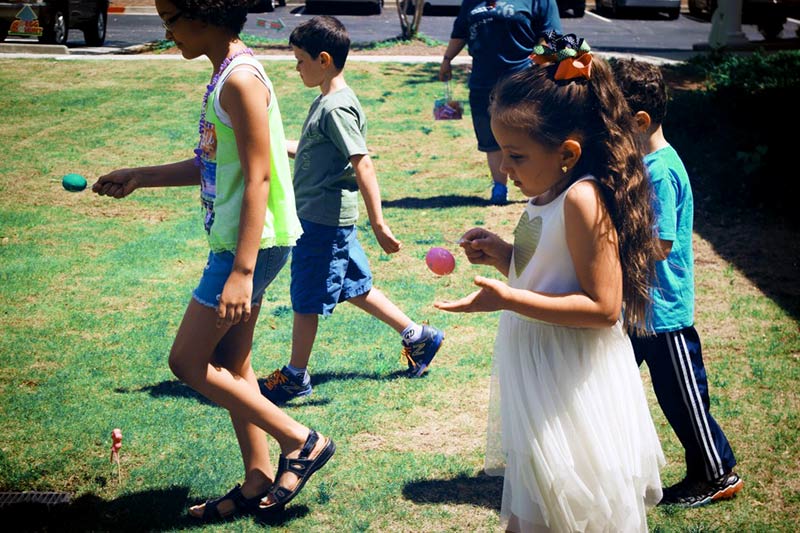
The Egg Walk Balancing Game
What You’ll Need:
• Plastic or wood Easter eggs
• Bucket to hold the eggs
• Easter baskets
• Several kitchen utensils
How to Play:
Keep the wooden or plastic eggs in a bucket to keep them contained for the game. Depending on how many utensils you have will determine how many baskets you will need. For every utensil, there should be an equal amount of baskets. Set each Easter basket down across the room from the bucket that contains the eggs. To play, an egg is balanced on each one of the utensils, and the player will need to walk from the bucket to the Easter basket without the egg falling off. To make the game more competitive, play with multiple players and see who can get the most objects into their Easter basket within a certain period of time. If an egg drops off of a utensil, put the egg back into the bucket so they would need to start again from the beginning.
The Egg Shaker Guessing Game
What You’ll Need:
• Plastic Easter eggs (empty)
• Small objects to fill the eggs (i.e. marbles, coins, beads, balls, etc.)
How to Play:
Similar to the sound matching game, gather small trinkets to fill the Easter eggs that are different from each other (i.e., beads, crystals, coins, balls, rocks, etc.). It is important that you find objects that will offer a distinct sound. Once you have your items, but what you have in each plastic Easter egg. So you would put the coins all in one egg, rocks all in one egg, and so forth. In this game, you do not want any of the objects to sit outside the egg. To help you remember what each egg has, write it down. If you have different colored eggs, aim to have different colors so you can match the colors to what you have written down. If this isn’t possible, then you could simply number the eggs with a sharpie marker, and then write down the information. Once this has been done, have the child pick up an egg and shake it. Going by the sound alone, they would need to guess what is inside the egg.
Frequently Asked Questions
Hearing-friendly Easter games stimulate children's senses, helping them develop their auditory and sensory processing skills in a fun and engaging way. These activities support overall development by encouraging exploration and learning through play, which is crucial for young children's growth.
You will need empty plastic Easter eggs and small pairs of objects that can fit inside the eggs, such as marbles, coins, beads, or balls. Ensure you have duplicates for each object to create matching sound pairs.
Place plastic or wooden eggs balanced on kitchen utensils and have players walk from a bucket holding eggs to Easter baskets set across the room. Players must carry the eggs on utensils without dropping them. If an egg falls, it goes back to the bucket and they start over. The goal is to transfer as many eggs as possible within a time limit.
To keep track of the different objects inside the eggs, you can color-code the eggs or number them with a marker. Then, write down the corresponding contents for each egg, which helps children guess the objects based on the sounds they hear when shaking the eggs.
Small, distinct objects that create unique sounds when shaken, like marbles, coins, beads, balls, rocks, or crystals, work best. The differing sounds help children identify and match the eggs during the games, enhancing their auditory perception.
Yes, participating in these hearing-friendly Easter games together encourages interaction and shared fun, which helps strengthen bonding between parents, children, and other family members while supporting the children's sensory development.